Facial gua sha: risks, contraindications and precautions
Facial gua sha is not dangerous when it is done gently, on healthy skin and with a clean tool. Here are the contraindications, the questions to ask your client, what you can promise and how to look after the tool.
- By The Pommette team
- 8 min read
Updated 16 November 2026. Medical sources and legal texts checked on 16 November 2026.
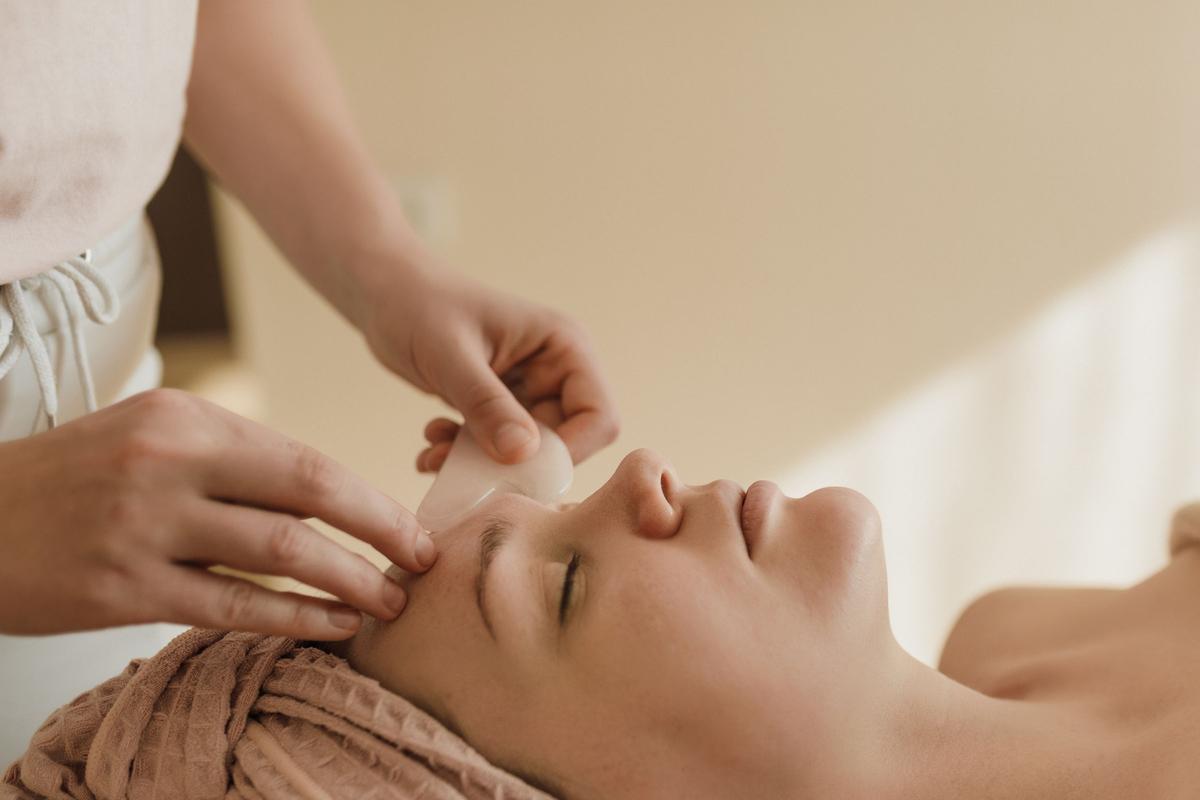
Facial gua sha is not dangerous when it is done with light pressure, on healthy skin, with a clean and undamaged tool. The risk comes from the situations where you should not do it: irritated or broken skin, a skin condition, blood thinners, recent injections, pregnancy or ongoing medical care.
So your work starts before the session, with the right questions for your client.
One reminder first: you do not make a diagnosis. When an answer makes you hesitate, you refer the client to her doctor and wait for the doctor’s agreement before the treatment.
Why do people talk about gua sha being dangerous?
Because traditional gua sha has little in common with what you do in your treatment room. In traditional Chinese medicine, it means firmly scraping the skin of the back or shoulders with a smooth edged tool. The stated aim is to bring up red or purple marks. Cleveland Clinic explains that these are petechiae, tiny bleeds under the skin caused by broken capillaries. To explain to a client how gua sha differs from kobido or maderotherapy, see our article on Japanese facial massage.
A pilot study published in 2007 in the journal Explore, carried out at the University Hospital of Essen on 11 healthy volunteers, measured a fourfold increase in microcirculation on the treated back for the 7.5 minutes after the session. It is a small study, on the back, not on the face.
On the face, the beauty version uses very light pressure. The same Cleveland Clinic page points out that facial skin is thinner and should not be pressed hard: a little redness may appear, without pain. The videos showing marks or bruises after a “facial gua sha” show exactly what to avoid.
So the danger comes down to three things: too much pressure, skin that should not have been massaged, and a dirty or chipped tool.
What are the contraindications for facial gua sha?
Medical sources on gua sha are still few, and no study has set an official list. The table below brings together what Cleveland Clinic and the American Academy of Dermatology say. For any case not listed, the rule is simple: ask for a doctor’s advice.
| Client’s situation | What you do | Source |
|---|---|---|
| Irritated or inflamed skin, wound, sunburn, rash | No gua sha on that area | Cleveland Clinic |
| Eczema, psoriasis | No gua sha without medical advice | Cleveland Clinic |
| Rosacea | No rubbing or massage on the affected skin | American Academy of Dermatology |
| Blood thinners or aspirin | No gua sha without medical advice | Cleveland Clinic |
| Circulation problems, diabetes | No gua sha without medical advice | Cleveland Clinic |
| Ongoing chemotherapy | No gua sha without medical advice | Cleveland Clinic |
| Pregnancy | Advice from her doctor or midwife before the treatment | Cleveland Clinic |
| Swollen area | Leave the area out | Cleveland Clinic |
| Recent botulinum toxin | No rubbing on the area for 12 hours, no facial for at least 24 hours | Cleveland Clinic |
| Hyaluronic acid or other injections | Ask the injecting doctor | No solid medical source |
“Medical advice” means the client sees a doctor, not that you judge for her. And a contraindication can be temporary: a sunburn fades. In that case, offer another appointment rather than a treatment adjusted by guesswork.
Questions to ask before the session
The safest approach is to ask every new client the same questions, in writing, then go over them quickly at each visit:
- Do you have a skin condition (eczema, psoriasis, rosacea) or any irritation right now?
- Are you taking anything that thins the blood, including aspirin?
- Have you had facial injections (botulinum toxin, hyaluronic acid), and when?
- Are you pregnant, or followed for diabetes, a circulation problem or cancer treatment?
Write down the answers and the date in the client record. If you advised her to see a doctor, note that too. When a client comes back three months later after injections, you will know what to ask again.
What precautions should you take during the treatment?
Once contraindications are ruled out, the technique itself matters. Here is what comes up in Cleveland Clinic’s advice, plus some treatment room common sense.
Apply an oil or serum. It lets the tool glide instead of dragging the skin. Dry skin under the stone is skin that pulls.
Keep the pressure light. Slight redness is normal, marks are not. If the client says it hurts, stop or lighten up at once. Cleveland Clinic is firm on this: a painful session does no good.
Work in one direction. Start at the centre of the face and move outwards, in straight lines, without going back and forth. Back and forth strokes stretch and irritate the skin.
Avoid swollen areas and pressing around the eyes. On a swollen area, too much pressure can burst capillaries and leave a bruise.
After the treatment, tell the client that slight redness may last a little while. If she notices bruising, pain or redness that does not settle, she should let you know and see a doctor if it does not improve.
What can you promise a client?
Less than you read on social media. Cleveland Clinic acknowledges that there is not enough high quality research to state the benefits of gua sha, and that reduced facial puffiness, often highlighted, has not been studied.
French law points the same way. Article L121-1 of the French crafts code defines aesthetic massage as a treatment “for an exclusively aesthetic and comfort purpose, excluding any medical and therapeutic purpose”. And article L121-1 of the consumer code prohibits misleading commercial practices.
In practice, here is what you can write on your menu or booking page, and what is better removed.
| Remove | Use instead |
|---|---|
| Lifting effect, replaces injections | A relaxing moment, skin feels toned |
| Drains toxins, detoxifies | Facial massage with a tool, slow and light movements |
| Treats acne, rosacea, migraines | Nothing: these are medical topics |
| Guaranteed results from the first session | How it feels varies from person to person |
Be wary of before and after photos taken right after the treatment, too. Freshly massaged skin often looks pinker and brighter for a while, which says nothing about a lasting result. If you post a photo, show the treatment, the room, the tool, rather than a transformation.
The same reasoning applies to drainage: our article on salon drainage versus physiotherapy lists the words that turn a wellbeing treatment into a medical promise.
How do you clean and disinfect a gua sha tool?
The tool touches every client’s skin. It must be cleaned after each treatment, and you need enough of them never to reuse a stone that has not been treated.
After each client, remove the oil with soap and water, rinse and dry. Then disinfect with a product suited to the material, following the instructions of both the tool maker and the disinfectant, especially the contact time. Cleveland Clinic notes that some tools can take boiling water or a diluted bleach solution, but that is not true of every stone: check first.
Inspect the edge at every cleaning. A chipped or cracked tool can cut the skin and holds dirt more easily. Cleveland Clinic is clear: if it is damaged, stop using it and replace it.
Store clean tools apart, in a closed box, away from those waiting to be cleaned.
If you are thinking of adding gua sha to your menu, work out the room time, products and cleaning before setting the price, as in our method for pricing your facials.
Frequently asked questions
Is gua sha dangerous?
No, when it is done on the face with light pressure, on healthy skin and with a clean tool. The side effects Cleveland Clinic mentions, such as bruising or marks, mostly come from too much pressure. Some situations call for medical advice before the treatment, such as blood thinners, pregnancy or a skin condition.
Can you do gua sha on acne prone skin?
Not on inflamed spots, nor on irritated or broken skin: Cleveland Clinic advises against gua sha on any inflamed skin. With established acne, the client should first ask her doctor or dermatologist. You can leave the area out or postpone the treatment.
Can you do gua sha after injections?
After a botulinum toxin injection, Cleveland Clinic advises not rubbing the area for 12 hours and waiting at least 24 hours before a facial or facial massage. For hyaluronic acid and other injections, ask the doctor who performed them. Note the injection date in the client record.
Should a client fill in a form before gua sha?
None of the texts cited here require it, but it is the simplest way to spot a contraindication. A written, dated form that you go over at each visit means you never forget a question.
In summary
Facial gua sha is done gently, on healthy skin, with a clean and undamaged tool. Contraindications are spotted before the treatment, with simple questions that you write down. At the slightest doubt, the client asks her doctor. On your menu, talk about relaxation and comfort, not lifting or detox. Pommette, which opens at the end of 2026, includes at launch a contraindications form that the client fills in before her appointment, then stored in her record.
Sources: Cleveland Clinic, “Gua Sha: What It Is and How To Do It” (September 2025) and “Botox Aftercare: The Dos and Don’ts”; American Academy of Dermatology, “7 rosacea skin care tips dermatologists recommend”; Nielsen A. et al., Explore, 2007, 3(5), pp. 456 to 466; French crafts code, article L121-1, and consumer code, article L121-1 (Légifrance). Accessed 16 November 2026.